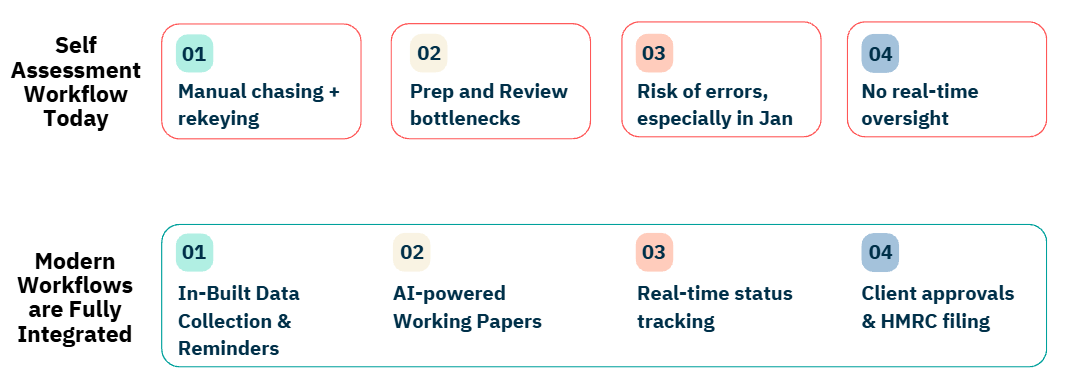
Most firms spend hundreds of hours on low-value prep work every tax season. The answer isn't more headcount — it's removing the manual steps that shouldn't exist in the first place.
The prep problem
Every January, accounting firms across the UK face the same challenge: a surge of Self Assessment work that overwhelms existing capacity. The instinct is to hire temporary staff or push existing team members to work longer hours. But neither approach is sustainable.
The real issue isn't volume — it's the proportion of time spent on tasks that add no value. Chasing documents, re-keying data, cross-referencing spreadsheets, and manually populating return fields are all activities that consume hours but don't require professional judgement.
Where the time goes
In a typical Self Assessment workflow, the breakdown looks something like this:
- 30–40% — Chasing clients for documents and information
- 20–30% — Manual data entry from source documents
- 15–20% — Cross-checking and reconciliation
- 10–15% — Review and sign-off
- 5–10% — Filing with HMRC
The first three categories — which account for the majority of time — are largely automatable. The professional value lies in review, advice, and sign-off.
A better approach
Rather than adding capacity, firms should focus on eliminating the manual steps entirely:
- Structured data collection replaces email chains with guided questionnaires tailored to each client's income profile.
- AI-powered extraction reads uploaded documents and maps the relevant figures directly to return fields.
- Automated reminders handle the chasing so your team doesn't have to.
The result is that your team spends their time on what actually matters — reviewing returns and advising clients — rather than on data entry and admin.
FOR ACCOUNTING FIRMS
Modernise your Self Assessment workflow.
See how Record OS reduces prep time and handles MTD cadence at scale.
Book a demo