How UK Accounting Firms Prepare Self Assessment Returns — And Where the Process Breaks Down
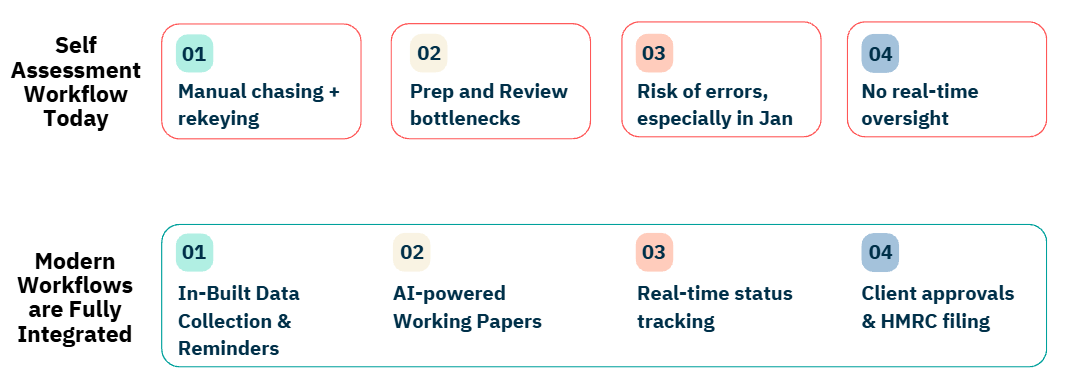
Self Assessment is core work for most UK accounting firms, and most practices follow a broadly similar Self Assessment workflow each year. But despite its importance, the process remains surprisingly manual at many practices — built around email, spreadsheets, and tax software that were never designed to work together.
The Typical Self Assessment Workflow
Although each firm has its own processes, the typical Self Assessment workflow used by most UK accountants looks something like this:
- Send a checklist or questionnaire to the client requesting documents and financial information
- Chase missing documents and review what's been received
- Manually enter figures into Excel working papers or internal templates
- Pass the draft return to a senior accountant or manager for review
- Re-key figures into tax preparation software (TaxCalc, IRIS, CCH, or similar)
- Send to the client for approval and file with HMRC
It works. But it's fragmented — and the fragmentation has a cost.
Where the Process Breaks Down
The biggest operational bottlenecks are consistent across firms:
Client chasing. Information arrives late, piecemeal, and across multiple emails. Accountants spend significant time following up before preparation can even begin.
Manual data entry. Figures are read from documents, typed into spreadsheets, then re-keyed into tax software. It's time-consuming, error-prone, and low-value work for trained professionals.
The January bottleneck. Many clients delay until the last moment, compressing the review workload into a short window and placing pressure on senior staff.
No workflow visibility. With information spread across email, spreadsheets, and tax software, it's difficult for managers to track where returns actually stand.
Why MTD Makes This Harder to Ignore
Under the current annual cycle, these inefficiencies can be absorbed — compressed into a busy January and written off as seasonal. Under MTD for Income Tax, the same fragmented workflow repeats every quarter. Manual data collection, document chasing, and re-keying figures don't disappear — they multiply. For firms that haven't redesigned their process, MTD doesn't just increase compliance obligations. It exposes exactly where the workflow is broken.
How Modern Firms Are Automating Self Assessment
Leading firms are moving away from disconnected tools towards unified workflows that cover the entire process — from client data collection through to HMRC submission.
The key capabilities that drive efficiency are:
- Structured client data collection that maps directly to tax return fields and replaces ad-hoc emails
- AI-powered document extraction: pulling figures from – for example – P60s, dividend statements, and bank interest certificates automatically
- Automated client reminders that do the chasing for you
- Exception-based review interfaces that show the original document alongside populated tax fields
The result: fewer hours per return, less manual entry, and real-time visibility across the entire Self Assessment workload.
How Record OS Supports the Full Self Assessment Workflow
Record OS is built specifically for UK accounting firms preparing Self Assessment returns at scale. The platform covers the complete workflow in a single system — structured client data collection, AI-powered document extraction, accountant review, client approval, and HMRC submission — eliminating the need to stitch together disconnected tools.
With MTD for Income Tax increasing reporting frequency from April 2026, firms that redesign their Self Assessment workflow now will be better placed to handle quarterly cadence without adding headcount.
If you're looking to reduce manual work and improve visibility across your Self Assessment operations, book a demo of Record OS.